Showing posts with label Tomato. Show all posts

Tuesday, November 20, 2018

Capsicum staffed with couscous and crispy roasted capsicum skins


This recipe is also about not wasting food!


It is very common to find capsicums (bell peppers) staffed with rice, but couscous can be as good. First boil wash well and the whole capsicums for 5-10 minutes to soften. In the meantime place a cup of instant couscous in a bowl that you can cover with a lid, add some olive oil, salt, and a mixture of dried and semi-dried tomatoes, cut into stripes. Cover with boiling water (and here you can use the capsicums water, if you want to save it!). Cover with a lid.


remove the capsicums from the hot water (use for the couscous) and cut the top off (careful, they will be hot!) and if it peels off easy, the skin. Keep the skin aside. When the couscous is nice and fluffy use it to fill the capsicums. At this stage you can add more things, like tempeh, tofu or anything you like. 


Place the capsicums top on and bake for approx. 30 mins.


You can also roll out the skins, brush with olive oil and sprinkle with salt and then bake until golden.


They will come out like thin crisps, super delicious, and perfect as an aperitif or as a garnish to your stuffed capsicums. A good way to use the skin of tomatoes and other vegetables too!


Photos and Recipes by Alessandra Zecchini ©

Monday, April 16, 2018

Schiacciata con pomodorini - cherry tomato schiacciata


 This schiacciata is easy as it doesn't need muck kneading.

For the schiacciata:
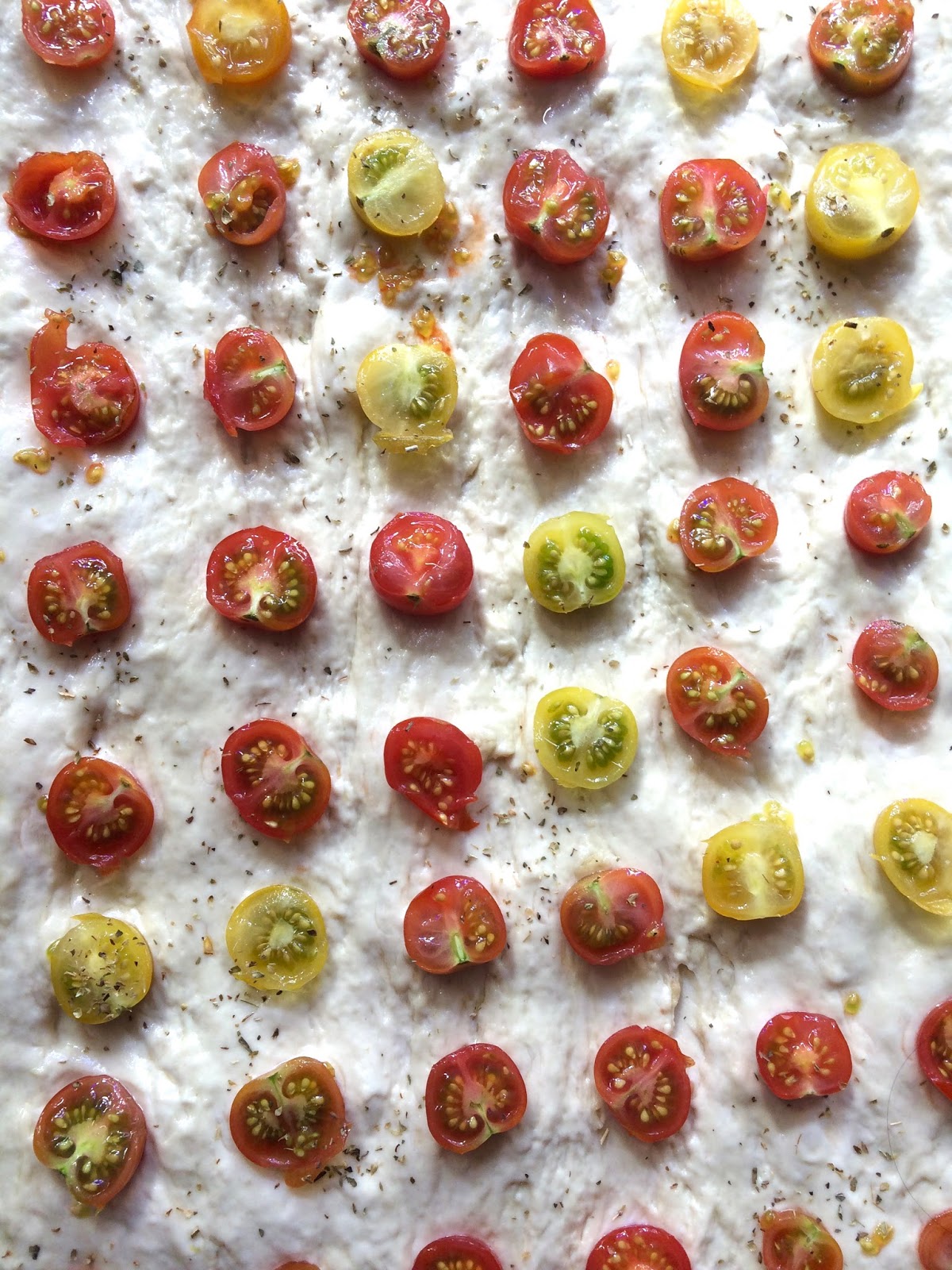
Place 300 ml warm water in a large mixing bowl, add 2 tsp active yeast granules and 1/4 tsp raw sugar. Wait 5 minutes then add 500 g high grade flour and 1 tbsp wheat gluten flour, plus a good pinch of salt. Mix well then dust with four, cover with cling film and let it rise for 2 hours. After 2 hours place a little olive oil on your hands and then gently mix the dough, pick it up and place it on a baking sheet cut so that it will fit you over tray (I have a 90cm oven so one long tray is good for me, for a standard oven divide the dough into two pieces). Roll the dough to cover the baking paper and then place on the baking tray. Brush with more oil if you like, then cut the cherry tomatoes into halves and place over the down, pressing them down lightly. Sprinkle with salt and oregano (chopped garlic too if you like).


Bake in a pre-heated oven at 200° C for approximately 20-25 minutes, or until you can see that the bread is baked on top and on the bottom (lift to check). Eaten warm is fantastic, but it keeps well for a couple of days, or at least, it would, but we tend to eat it pretty quickly! 


Photos and Recipes by Alessandra Zecchini ©

Sunday, July 10, 2016

Tomato tofu with vegetables and noodles


I learned to cook tofu with tomatoes from a Taiwanese friend 13 years ago, and I still remember thinking then how odd the pairing was… until I tasted it! Yes it works, and it is great! 


Heat some vegetable oil in a pan then add some fresh chopped tomato.


When the tomato is starting to mush add the tofu (use a firm type), cubed. Sauté on all sides then add two tbs of soy sauce (I use Japanese sou sauce). 


Add some green vegetables for colour (I use some pak choi), and cook for a few more minutes.


Boil the noodles, drain and add them to the pot, stir well with the tofu and vegetables.


Sauté the noodles for a few minutes, then add chopped coriander and chopped onion weed stalks (my Taiwanese friend would not have done that as she was a Buddhist vegetarian and ate no garlic, onion and chives, so I guess no onion weed!). Stir a bit more then serve, decorated with onion weed flowers.

Photos and Recipes by Alessandra Zecchini ©
Saturday, July 4, 2015

Arrabbiata sauce


 Please note that the chilies here are not mine except for the fat black one (I had two, a couple more still on the plant, not sure if I will ever harvest them though…). 


My son Max loves arrabbiata, one of his favourite sauces, as long as it is not toooo hot. So I just used one chili and put it in the pot with the cut up tomatoes. I cooked the lot until the tomatoes where mashy (most were cherry tomatoes so it didn't take long!), then I put the tomatoes through a sieve and collected the pulp minus seeds and peels. I cooked this until thick, added olive oil and salt, and the sauce was ready. Another way would have been to cook the tomatoes first and then add the chili to the tomato pulp, but this worked well. 


Photos and Recipes by Alessandra Zecchini ©

Monday, October 27, 2014

A basket of veggies from the garden to make salad


Freshly picked: tomatoes, basil, cucumber, radish, lettuce and mizuna.
Make a salad. I just add olive oil, salt and lemon juice so the dressing is not that expensive.
Photos and recipes by Alessandra Zecchini ©

Tuesday, February 18, 2014

Vegan and gluten free soup: Minestrone with veggies from the garden


Do you get tomatoes plants that die and leave you with green tomatoes hanging there not ripening? I do! What a pity, but even if some veggie are ugly I can still manage to make a soup out of them!


I don't know why the yellow zucchini plant is three times more prolific than the green one! Still, I am not complaining, look at the colour!


My favourite additions to soups are beans, it is just so much fun shelling them and look at the beautiful colours. Pity that they become all brown during cooking.


And here is the minestrone. No recipe, just wash, chop and boil, add salt to taste and extra virgin olive oil at the end. So tasty and healthy! Some of the photos are mine, but the prettiest are Arantxa's!


Photos and recipe by Alessandra Zecchini and Arantxa Zecchini Dowling ©

Saturday, November 16, 2013

Fregolotto (Fregola risotto)


 Outside Italy it is very difficult to find fregola, but Israeli couscous is readily available in many shops now, and can be a great substitute. 


Fregolotto

1 small onion
1 capsicum (any colour)
1 celery stalk with leaves
3 tbsp extra virgin olive oil
400 g fregola (or Israeli cous cous)
1 cup Italian tomato passata
1.5 l vegetables stock
Parsley and cherry tomatoes to decorate (optional)

Chop the onion, capsicum and celery, then sauté with olive oil. Add the fregola and stir, when hot add the Italian tomato passata and then, ladle by ladle, the vegetables stock, stirring constantly like when making a risotto. When the fregola is cooked and all the liquid absorbed serve, decorated with parsley and cherry tomatoes (optional).


Photos and Recipes by Alessandra Zecchini ©

Saturday, August 17, 2013

Tofu with Smoked Paprika and Pomodorini, vegan and gluten free main


This is a great vegan main, full of flavour and proteins. I cooked it for Bence and Judit, they like tofu and they asked for the recipe, so here it is:

Ingredients:

10 pieces of dry tofu (Japanese)
500 ml vegetable stock
2 shallots
4 tbsp extra virgin olive oil
1 tsp smoked paprika (or more, to taste)
1 can Italian cherry tomatoes (I used Mutti)
1 cup of water (to rinse the tomato can)
1 carrot
Salt to taste

I used ten pieces of dried tofu (like this one), soaked in 500ml of vegetables stock. Dry tofu is like a sponge and it will absorb flavors well (so use some good vegetable stock!). Then I sizzled a couple of finely slices shallots with 4 tbsp of extra virgin olive oil, then I added the tofu (soft after soaking in the vegetable stock) and sautéd it on both sides for a minute, then I added one tsp  (well, probably a bit more...) of smoked paprika, sizzled the tofu in the spice for a little longer, and finally one can of Italian cherry tomatoes, one cup of water, and one carrot, cut into thick slices). I cooked everything until the sauce was reduced and quite thick, and the carrots soft.

Add salt to taste and serve. Tofu is yummy!


Photos and Recipes by Alessandra Zecchini ©

Tuesday, November 27, 2012

5 Vegan school lunch boxes, mostly raw, eat your colours and 5+ a Day


Carrot and cucumber sticks, grapes, blueberries and Cape gooseberries, Olive focaccia (homemade)


When I was living in Japan I learned to present lunch boxes including a spectrum of at least 5 colours.
I try to do this with the kids' lunch boxes now, and these days the 5 + a Day is also promoting 'colours', which is a good way to make food more interesting. Of course here in NZ lunch boxes are stuffed down the school bag and tossed around, so I could never make them like real Japanese super pretty bentos, (I also wouldn't have the time in the morning or late at night!).

My problem has been trying to have 5 different colours all year round, especially for the blue! Fresh blueberries are easy, but when out of season I have to use frozen, good for smoothies and cereals and desserts, but not school lunches.


Avocado sushi, cherry tomato, banana, kiwi gold, feijoa, mandarin, grapes,  gluten free lunch box

If I don't have blueberries I try to put a few red/black grapes, is a pity that they are all imported, but so are the bananas. For the rest I always try to be seasonable and use fruit and veggies that grow in NZ, the tomato here was from my garden. Sushi only happens if there is some left over after dinner the night before: I could never get up at 5am to make it fresh!


Baguette with green salad and hummus with Dukka, banana, mandarins, kiwi gold, dried prunes

When I don't use grapes I try to add something close to purple/blue, like dried plums. Hummus is also another favourite filling, if they could my kids would have a hummus rolls every day, and they don't seem to be fussed if it smells of garlic.


Baguette with rocket salad, hummus and broad beans, orange, grapes and Cape gooseberries

Hummus again, this was just over a week ago, believe it of not I had broad beans in the garden, not enough for a meal, but enough for a couple of rolls. The Cape gooseberries too are from my garden.


Dolmas (rice wrapped in vine leaves), carrot sticks, cucumber and cherry tomatoes, banana, grapes and mandarin, gluten free lunch box

In Winter the lunch boxes are a bit repetitive: mandarins, banana, carrot sticks and grapes seem to dominate, and I occasionally buy cherry tomatoes even if they are grown in hothouses (but so are most cucumbers, I guess). The dolmas came from a can, a very occasional purchase, but it does add variety and, yes, the kids love those too!

But strawberries and blueberries and plums and colorful capsicums are coming in and the next lunch boxes will be easier to make!!


Photos and Recipes by Alessandra Zecchini ©

Thursday, November 22, 2012

Stuffed white cabbage leaves with lentils


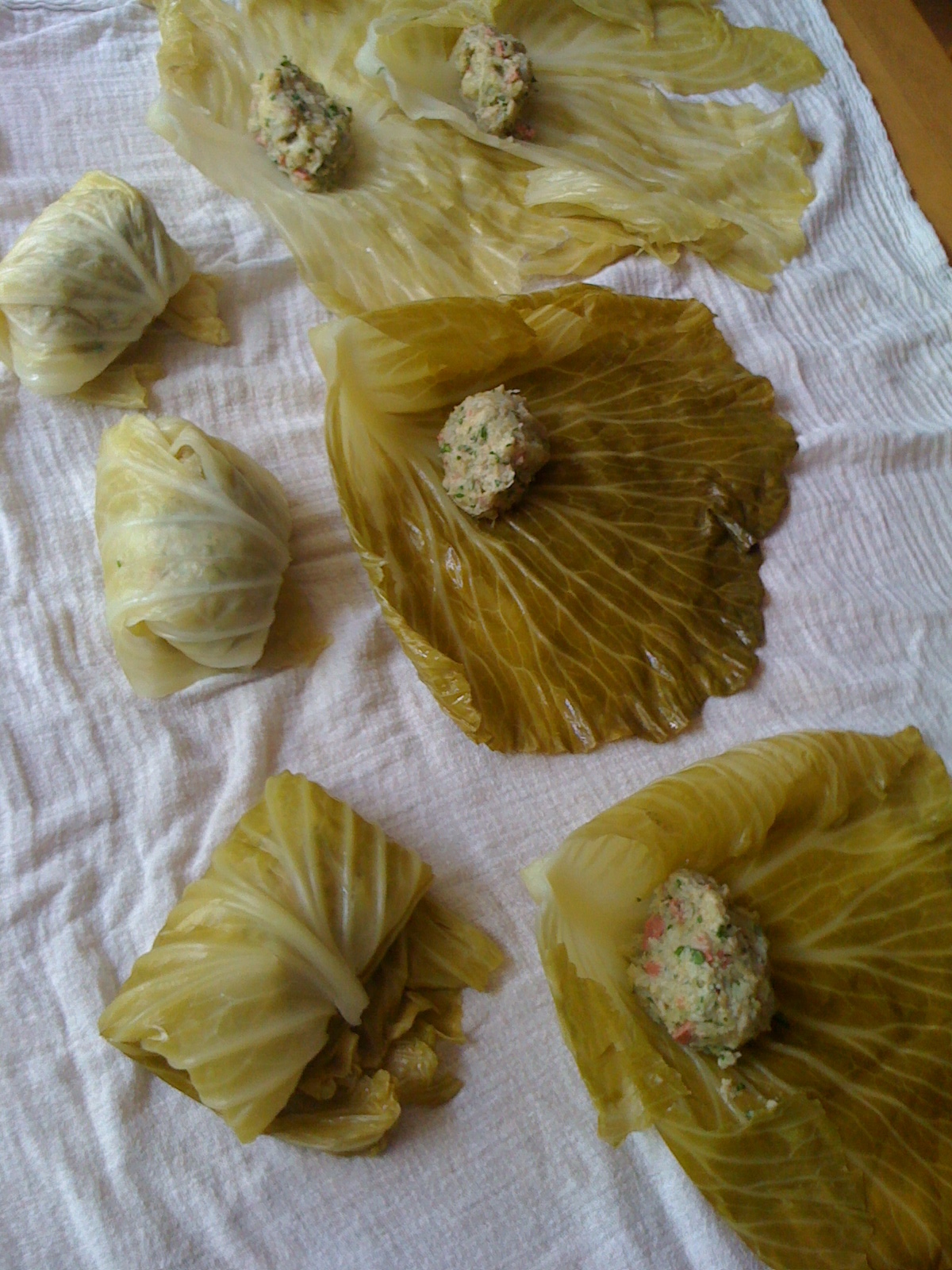
This is a first. I like stuffed cabbage leaves but I always use this dark green curly cabbages (like Savoy) to make them, and I never used the round and firm white cabbages that are used to make coleslaw. But I happened to have a big white cabbage and the outer leaves were sort of green... I managed to remove 7 leaves before the cabbage become to compact to pull apart. Then I washed them and boiled them in salted water (which I later used to make vegetable broth for an Asian noodle soup - never waste!). I also boiled a few more cabbage leaves that got broken while I was trying to pull them away: they were going to be used in the filling.


For the filling I used some cooked cabbage leaves, a couple of slices of vegetarian bacon, chopped parsley, breadcrumbs, smoked salt, chili flakes, coriander seeds and smoked garlic. I mushed everything with my hands and divided the filling between the 7 leaves, and then I rolled them up.


I prepared a soffritto with a shallot, half a carrot, a celery stick, and some chopped parsley, all sautéed with a little olive oil. 


I added the cabbage leaves and let them sauté on one side only for a few minutes.


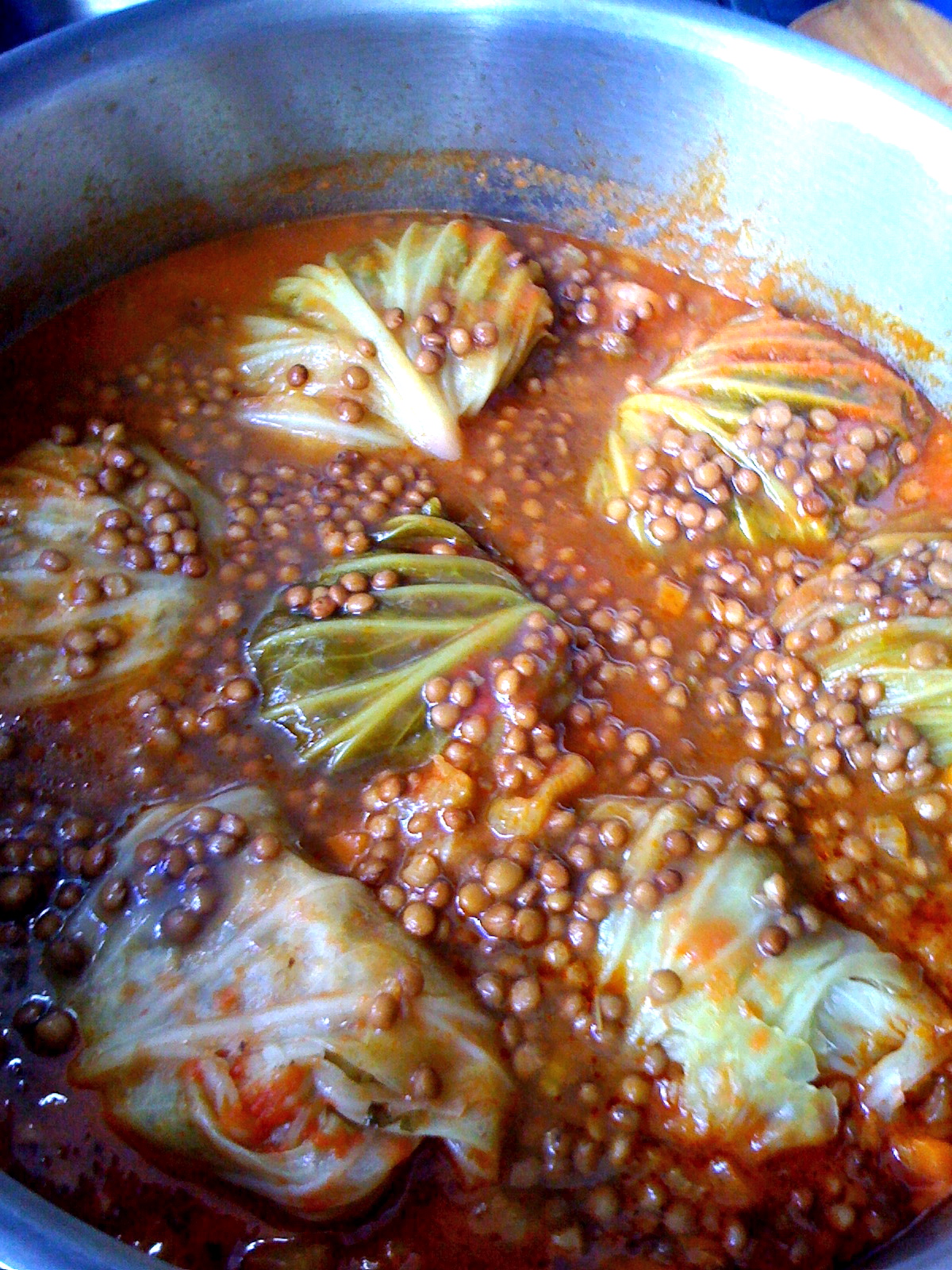
Then I added one cup of tomato passata (Italian tomato sauce) and one cup of vegetable broth. I covered the pot with a lid and let the cabbage rolls simmer for 30 minutes.


After 30 minutes I added the content of a can of Italian brown lentils (their water included) and simmered everything for another 30 minutes.


Well, I just managed to taste one, the other six were two each for the kids and the babysitter (I was teaching that night), to be eaten with bruschetta (actually, just a baguette cut into slices and the brushed with olive oil, sprinkled with salt and baked until golden and crispy, the kids just love it!!). The result? I was pleasantly surprised: I am not a fan of white cabbage, but in this way it tasted great! Pity that I could not get more leaves out of it, maybe I need to boil the whole cabbage and then try to pull off the leaves... next time I will try. Or maybe I will just go back to use my usual Savoy cabbages! :-)


Photos and Recipes by Alessandra Zecchini ©

Friday, July 27, 2012

Italian borlotti beans cooked in a skillet


 The most famous borlotti beans are from the village of Lamon (not far from my Mum's place).


Fagioli in Padella


Soak the borlotti beans overnight, rinse and then cook with plenty of water and a bay leaf. Usually I add salt only at the end of cooking, then I keep the broth and a few beans for soup, and drain the rest to cook separately or use them in salads. Here I made them 'in padella' (in a skillet).

Sauté a shallot (sliced) or a couple of peeled garlic cloves with two tbsp of olive oil. Add the cooked borlotti beans, then about one cup of Italian tomato sauce (passata) and one cup of bean broth (or vegetable broth). Simmer on low for about 20 minutes, when the sauce thickens add half a tsp of smoked paprika (or some black pepper), adjust for salt and then finish everything with some more olive oil and plenty of fresh chopped parsley. 

In the past I didn't use chopped parsley with the paprika, but I do now, if I can: I find that parsley makes the beans easier to digest without... gas! Do you use parsley agains the 'effects' of beans? I also know that kombu seaweed, and bay leaves, are supposed to help, but if you know any other trick do let me know :-).


Photos and Recipe by Alessandra Zecchini ©

Saturday, May 19, 2012

TTT: Taiwanese Tofu with Tomato


Ok, the TTT name is my invention, but the recipe is really Taiwanese. Several years ago I had a Taiwanese baby-sitter, she was also vegetarian (in Taiwan there is a strong vegetarian Buddhist tradition) and she didn't cook with garlic, onion, chives and leeks (this is the old Buddhist tradition). She taught me a lot of recipes... no, not recipes, maybe I should say 'ways of cooking'.

This recipe is so basic that I almost thought of not putting it on the blog, but the fact is that it is quite amazing!! In my Italian brain I never thought of combining tomatoes with tofu and soy sauce this way, it didn't feel right, and I was quite skeptical when she showed it to me. And then I tasted it: WOWOWOW, it works!

And not only it works, the kids love it, and it is so easy and quick... and in a way it feels so ... ethical!
Yes, just a few low cost ingredients, not much time or energy needed, and lots of proteins.

I usually used some red ripe tomatoes, but I had some ripe little orange tomatoes to finish, and so they went: cut and placed into the frying pan/wok/pot with a little vegetable oil (olive oil works well) and a small pinch of salt. Of course you could also add garlic, but the original recipe, as I said before, doesn't allow for allium of any type. Cook on high, stirring constantly, when the tomatoes start to mush into a sauce add the cubed tofu, stir and then add one or two tbs of soy sauce (I use only Japanese soy sauce, Kikkoman or Yamasa) or gluten free tamari sauce if you are gluten free, and stir until the tofu is really hot (a couple of minutes only). Top with fresh chopped coriander if you like, and serve immediately with rice or noodles.


Photos and Recipes by Alessandra Zecchini ©


I enter this recipe in Cooking to Combat Cancer


Sunday, January 22, 2012

So many ways to eat a coconut!


When we were in Niue Charles and Colleen came for dinner. Of course I made pasta, but I also made a variety of dishes with the fresh coconuts they brought me the day before. A tomato and coconut salad with cannellini beans, spring onions and olives, dressed with olive oil, lemon juice and sea salt flakes. Coconut rice (just boil the rice with coconut pieces in it, fantastic!), coconut chocolates: I dipped slices of coconut in melted 72% dark chocolate, and also mixed freshly shredded coconut in the remaining chocolate to make choco-coco balls. I made a big tray of these but I forgot to take a photo, se here were the leftovers... and the fruit salad with local papaya, banana, and coconut, a little brown sugar, lemon juice and rum. This I made a few times actually, it was too good! Charles and Colleen couldn't believe how many things I made out of their coconuts, they said that usually the drink the juice and then give the rest to the pigs. They have plenty of coconut. But I guess that for me this was luxury!


So what is a typical dish with coconut in Niue? In the market we tried the local coconut porridge, a warm mixture made with coconut, arrow root and a little sugar. It was different, not bad but not even my breakfast of choice. I preferred coconut bread, which is sold in all the bakeries.


But the best experience for me was to learn how to open and eat coconut at different stages of maturity, so if one day I will be ever stranded on a desert island I will be able to survive... as long as there are coconuts around! On our plantation tour Tony firstly gave us a coconut each to drink, these were very young coconuts and the water tasted different from the one we collected from Charles' coconut. Then Tony opened up some coconuts for us and cut some spoons out of the coconut shells. The younger the coconut the softer the flesh.


I was really surprised to learn that you can also eat coconut when the leaves appear: Tony called it coconut marshmallow, and in fact it was soft (but not as soft as a marshmallow) white and spongy, with a delicate sweet taste, a bit like eating a gigantic soft macadamia nut. This was a favourite with the kids. My favourite was the the stalk of the young coconut plant: Tony peeled and passed it over, crunchy, fresh and a bit like a coconut celery. I have eaten this before, it is called heart of palm, and in Argentina I ate it in sandwiches (it is called palmito there), in Asia I ate it in a variety of dishes, and in New Zealand I went on a foraging trip with a Maori forest ranger and ate the heart of a young Nikau palm (but much smaller than this stalk of coconut!). Nikau heart too taste a little like coconut.


So if you visit Niue make sure that you visit a plantation, the market, or have friends with lots of coconuts, otherwise just  stop at your nearest coconut stall.


Photos and Recipes by Alessandra Zecchini ©